




Opera libretto by Carlo Goldoni (115 pages)
Authenticated by International Expert Renato Saggiori as fully handwritten by Carlo Goldoni
Contact : goldoni@goldoni-talismano.com
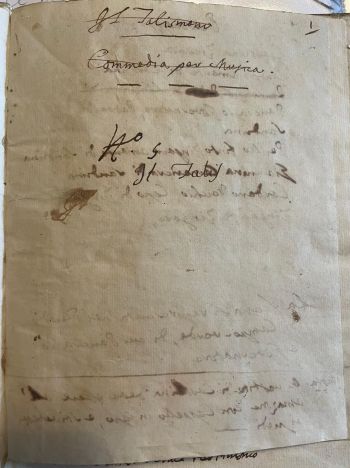
First page of manuscript with Title Il Talismano and indication as Commedia per Musica (image)
International Expert in Ancient Manuscripts and Autographs
The complete 115-page manuscript of Il Talismano has been examined and certified as entirely autograph by Renato Saggiori (Geneva).
Il talismano (The Talisman) is a dramma giocoso per musica (comic opera libretto) written by Carlo Goldoni in 1779, one of his final works. The libretto was set to music by Antonio Salieri (for the first act) and Giacomo Rust (for the subsequent acts), with revisions by Lorenzo Da Ponte. It premiered on August 21, 1779, at the Teatro alla Canobbiana in Milan, to inaugurate the theater.
The story revolves around romantic misunderstandings and a magical object. The governor Pancrazio wants to marry his daughter Sandrina to Lindoro. However, Lindoro is in love with the gypsy Carolina and has no intention of marrying Sandrina.
Meanwhile, Perillo, who is in love with Sandrina, has fled and joined the gypsies because Pancrazio disapproves of their relationship.
To allow the four young lovers to unite according to their own wishes, Carolina uses a talisman given to her by the gypsy chief Cardano. This talisman enables her to change her appearance and identity at will, leading to a series of deceptions, disguises, and tricks aimed at outwitting Pancrazio.
The work is a light-hearted comedy filled with wordplay and misunderstandings, typical of the 18th-century opera buffa genre, incorporating elements of magic and gentle social satire.
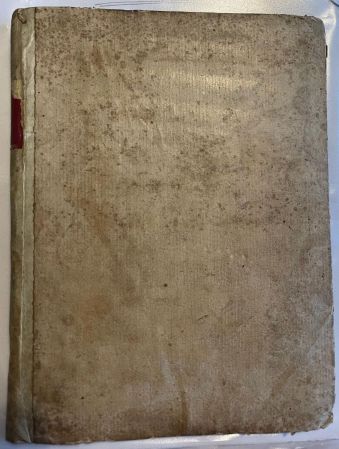
Commedia Cover (image)
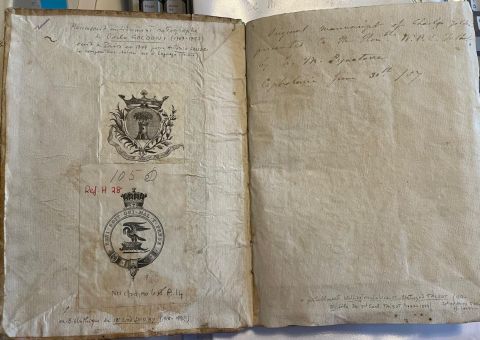
Ex-Libris Lord Derby at Knowsley Hall (Coats of Arms with Crown and Eagle) (image)
Il Talismano is a significant work in Carlo Goldoni's career primarily because it represents one of his last contributions to musical theater. Written in Paris in 1779, when the author was 72 years old and recovering from a heart attack, this libretto marks a new stage in his literary development. After reforming spoken comedy, Goldoni elevated opera buffa to an unprecedented level of sophistication, blending misunderstandings, disguises, magic, and a deep sympathy for women’s rights and the wandering cosmopolitanism of the Romani people.
The talisman itself symbolizes this “transmutation” and illusionism, while objectifying the illusions of love and identity. Gone are the fixed masks and improvised lazzi of the Commedia dell’Arte: everything here is carefully written, sung, and structured for music. Goldoni infuses the genre with psychological and social depth that foreshadows the masterpieces of Lorenzo Da Ponte and Mozart.
This manuscript directly connects three giants of opera: Antonio Salieri (who composed the first act), Giacomo Rust (for the subsequent acts), and Lorenzo Da Ponte, who later revised the work and became Mozart’s legendary librettist for Le nozze di Figaro, Don Giovanni and Così fan tutte. Il Talismano thus represents a unique historical link between Goldoni’s reform of opera buffa and the Mozartian golden age.
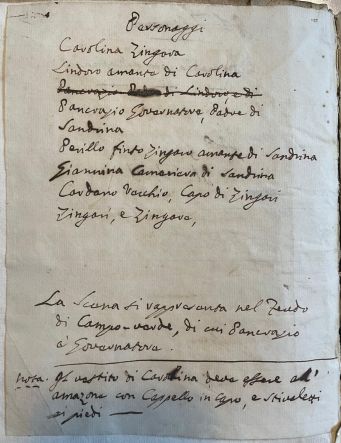
List of Il Talismano Commedia characters (image)
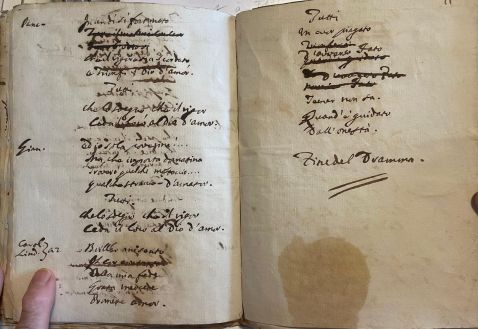
Last two pages with last words, Fine del Dramma (image)
This manuscript represents an exceptionally rare example of a complete creative genesis: Carlo Goldoni did not simply transcribe an already finished text, but worked from the blank page. Through successive drafts, crossings-out, additions and pasted sheets, the document reveals the entire process of composition of the libretto, from the first idea to the definitive version. It is a true author’s workshop, in which one can follow the living work of Goldoni’s writing: the hesitations, the rewritings, the stylistic and dramaturgical choices that led to the final text. Manuscripts of this kind – which fully document the passage from the blank page to the completed work – are extremely rare in Goldoni’s output and constitute a primary source for genetic criticism and for the history of eighteenth-century theatre and opera.
There are currently two known complete autograph manuscripts of comedies/dramas by Carlo Goldoni: